
WhatsApp vs Instagram vs Messenger for Lead Gen: An Honest Comparison
All three are owned by Meta, but they behave very differently when you try to generate and qualify leads. Here's a practical, side-by-side look at how WhatsApp, Instagram DMs, and Messenger compare for inbound sales in 2026.
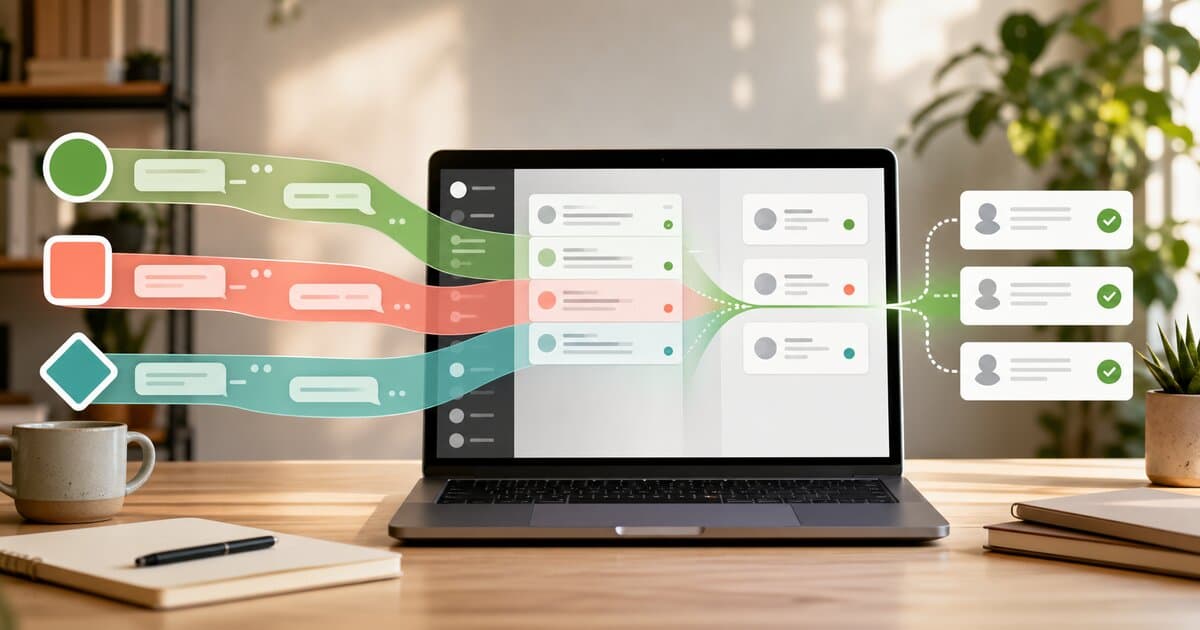
Three messaging channels. One parent company. Completely different rules.
That's the strange thing about WhatsApp, Instagram DMs, and Messenger. Meta owns all of them, but each one behaves like a different planet when you actually try to use it for lead generation. The 24-hour rule means something different on each. The audience expectations are different. What you can send after the window closes is different. Even the inbox UI nudges you toward different behavior.
Most owners pick one channel because it's the one their customers seem to use, and figure it out as they go. That works for a while. Then growth happens, leads start coming in across all three, and the seams start to show.
This post is the cheat sheet I wish someone had given me the first time I had to think about all three at once.
The 30-Second Verdict
If you only have time to read one paragraph:
Instagram DMs are the best top-of-funnel channel for consumer businesses. Lowest friction, highest discovery, but tight follow-up rules. WhatsApp is the best closing channel. Highest open rates, freest in-window conversation, real follow-up tools through templates. Messenger is the steady workhorse for Facebook-driven traffic, especially older or suburban audiences in the US.
Most growing businesses use all three together, with each channel doing what it's best at. The trick is matching the channel to the stage of the conversation, not the audience.
The Comparison at a Glance
| Dimension | Instagram DMs | Messenger | |
|---|---|---|---|
| Audience location | Personal phone, daily | Mobile, content-driven | Mostly Facebook app |
| Message open rate | Very high | High in-app | Solid |
| Friction to start | Need a phone number | One tap from any post | One click from FB |
| 24-hour window | Strict | Strict, less flexibility | Flexible via message tags |
| Outbound after 24h | Approved templates | Not allowed | Limited message tags |
| AI assistance | Allowed if purpose-driven | Allowed if purpose-driven | Allowed if purpose-driven |
| Best for | Closing and qualifying | Discovery and warm inbound | Ad-driven inbound from FB |
| Audience skew (US) | Broad, growing | Younger | Older |
The rest of this post unpacks each of those rows in plain English.
WhatsApp: The Closing Channel
WhatsApp has the highest open rates and the deepest customer attention of any messaging platform. When you send a message inside the 24-hour window, it gets read. Almost always. Often within minutes.
That's a double-edged thing. It means WhatsApp is incredibly powerful for closing, qualifying, and nudging warm leads forward. It also means the platform takes spam very seriously, and Meta's 2026 AI policy made it very clear that general-purpose chatbots are no longer welcome. AI is allowed, but it has to be doing a focused business job.
The 24-hour window matters more than anywhere else. Inside the window, you can converse freely. Outside it, you can only send pre-approved templates, which work fine for booking confirmations and reminders but are not great for sales nurture. We covered the 24-hour rule in detail here if you want the long version.
The friction is the phone number. WhatsApp is a phone-number-based platform. Customers either need to know your number or click a "Click to WhatsApp" link from your website, ads, or QR codes. That friction is also a feature: people who reach your WhatsApp tend to have higher intent than people who slide into your Instagram DMs.
WhatsApp Business API is the serious tier. If you're using the regular WhatsApp Business app on a phone, you'll outgrow it fast. The API tier is what lets you connect to a CRM, run an AI assistant, route messages to multiple team members, and not lose conversations. Most reputable lead-gen tools work with the API tier, not the app.
WhatsApp is best for moments where the customer is far enough along to want a real conversation. Booking inquiries, service questions, follow-ups on quotes, reactivation of past customers (via templates), and live qualification.
WhatsApp is bad for cold discovery. If you're trying to attract first-time strangers, WhatsApp is the wrong place to start. Get them into your funnel through ads, content, or your website first, then move them to WhatsApp once they've raised their hand.
Instagram DMs: The Discovery Channel
Instagram is where attention happens in 2026. People scroll, watch, and discover. The DM is the natural place a discovery becomes a conversation.
The strength of Instagram DMs is that the friction to start one is essentially zero. A customer sees your reel, your post, or your story, taps "Send Message," and they're in your inbox. No phone number, no form, no page-load. That's why Instagram is the best top-of-funnel messaging channel for consumer businesses by a wide margin. (We wrote a longer post specifically about why DMs are your cheapest sales channel if you want to dig in.)
The downside is depth and follow-up. Instagram has a 24-hour reply window similar to WhatsApp, but with no template system. If a conversation goes cold for more than a day, you're locked out unless the customer messages you again. You can't proactively nudge them like you can with a WhatsApp template.
Notifications get drowned. Inside the Instagram app, DMs share space with likes, story reactions, follower notifications, and a hundred other distractions. Customers who don't actively check their DMs may miss your reply for hours, even if it arrived in seconds.
Story replies and comments collapse into DMs. This is one of Instagram's best lead-gen features. Every time someone replies to your story or you reply to a comment with a DM, you've started a conversation in the inbox. Used well, this turns content into pipeline.
Message Requests is a graveyard. People who don't follow you (a lot of potential customers) end up in the Requests folder, which most owners don't check daily. If your AI tool isn't surfacing those, you're losing leads you don't even know about.
Instagram DMs are best for initial inquiries from warm followers, conversion of content viewers into leads, qualification before pushing a customer to call or visit, and capturing a phone number so you can move them to WhatsApp.
Instagram DMs are bad for long-running deals that need multi-day nurture. The 24-hour rule with no templates makes it hard to reactivate cold threads. You almost always want to capture a phone number or email inside the conversation, so you have a way to follow up if the DM goes silent.
Messenger: The Steady Workhorse
Messenger is the channel that nobody talks about, which is exactly why it works.
A huge portion of US adults still use Facebook every day. That audience skews older and more suburban, and (for many service businesses) more buying-active than Instagram's audience. If your business runs Facebook ads, has a Facebook Page, or shows up in local search through Facebook, Messenger is part of your inbound flow whether you've planned for it or not.
The 24-hour window applies, but with message tags. Messenger has a system of "message tags" that let you send specific kinds of messages outside the 24-hour window, including appointment updates, post-purchase updates, and account updates. It's more flexible than Instagram, less flexible than WhatsApp templates, and easy to misuse if you're not careful.
Click-to-Messenger ads are a real channel. Meta has invested heavily in click-to-Messenger ad formats, and they convert well for service businesses with a clear offer (consultations, free quotes, info downloads). If you're running Facebook ads at all, sending the click into Messenger instead of a landing page is often a better move.
The audience overlap with WhatsApp is partial. A lot of Messenger users do not use WhatsApp regularly, especially in the US. So if you only support WhatsApp, you're skipping a chunk of your audience. The reverse is also true.
It's the most "office hours" of the three. Messenger conversations tend to happen at slightly more leisurely paces. Customers are more likely to come back hours later to continue, less likely to expect a 30-second reply.
Messenger is best for Facebook-driven traffic, click-to-Messenger ads, businesses whose audience lives on Facebook, and lead-gen funnels for older or suburban demographics.
Messenger is bad for anywhere your audience is mostly on Instagram or WhatsApp. If your customers don't use Facebook, Messenger isn't going to magically attract them.
How to Use All Three Together
Most growing businesses don't pick one of these channels. They use all three, but they think about each one as a different stage in the customer journey instead of a different audience.
A simple structure that works for most businesses:
Top of funnel: Instagram and Messenger ads. Run discovery campaigns on Instagram (Reels, Stories, Explore) and Messenger (Click-to-Messenger ads if your audience is older or Facebook-heavy). Don't try to convert in the ad. Just get the conversation started.
First conversation: Instagram DMs and Messenger. Let the first conversation happen wherever the customer started. Don't make them switch platforms in their first reply. Use that conversation to qualify, build rapport, answer the obvious questions, and capture two things: their genuine intent and a phone number.
Mid-to-bottom of funnel: WhatsApp. Once you have the phone number, you have permission (implicit, since they shared it for follow-up) to move the deeper conversation to WhatsApp. WhatsApp is where you book the appointment, send the quote, follow up on questions, and close. It's also where you can use templates to nudge a customer 48 hours later if they go quiet.
Reactivation: WhatsApp templates and email. Beyond the 24-hour window, your only proactive channels are WhatsApp templates (for things like reminders and offers) or email. Don't try to reactivate dormant leads on Instagram or Messenger. The platforms don't really allow it cleanly.
This three-stage flow is what most modern lead-gen setups look like. The mistake is trying to do everything on one channel, or chasing the customer between channels in a way that feels disorganized to them.
Three Mistakes to Avoid
A few patterns that show up over and over with small businesses trying to get this right:
1. Treating each platform like a separate inbox with separate rules. Customers don't think in platforms. They think in conversations. If a customer DMs you on Instagram, then later WhatsApps you, they expect you to remember the previous conversation. That means using a tool (or a discipline) that unifies the inboxes, even if the channels are technically separate.
2. Replying differently on each channel. Some businesses sound chatty and casual on Instagram, then formal and templated on WhatsApp, then awkward on Messenger. Customers can tell. Pick a tone that works for your business and use it everywhere. Personal-but-professional is a safe default.
3. Not capturing a phone number inside the first conversation. Whatever channel the customer started on, get a phone number politely and naturally inside the first few messages. It's the single most important piece of lead data, because it gives you a way to follow up no matter what platform goes silent.
Where Replypop Fits
Most tools handle one of these channels well and the other two as afterthoughts. Replypop is built around the assumption that you'll use all three, with the same brand voice, the same qualification rules, and the same lead in your CRM no matter where the conversation started.
A few specifics worth knowing if you're comparing options:
One inbox, three channels. A customer who messages on Instagram and later WhatsApps you appears as the same person, with conversation history available across both. Your team doesn't have to play detective.
Channel-aware rules. Replypop knows the 24-hour window applies to WhatsApp differently than Instagram, knows that Messenger has tags, and stays inside the rules for each platform. You don't have to think about it.
Capture-the-number is built in. On Instagram and Messenger, where outbound after 24 hours is restricted, the assistant naturally collects a phone number during qualification, so the lead doesn't go dark just because the platform window closes.
Purpose-driven, not general-purpose. This matters because of Meta's 2026 policy on AI. Replypop's assistant has a clearly defined job (qualify and route inbound leads) and doesn't go off-topic. That's both a better customer experience and what the platform now requires.
We're not the only option, and we won't pretend any tool fits every business. But if you're juggling all three channels and feeling like leads are slipping through the cracks, the unified-inbox-with-structured-AI pattern is probably the right shape of solution, whether you choose us or someone else.
Wrapping Up
WhatsApp, Instagram DMs, and Messenger aren't competing channels. They're different stages in the same conversation. The businesses that figure out how to use them together (Instagram for discovery, all three for first conversations, WhatsApp for closing and reactivation) build lead-gen flows that quietly out-convert businesses spending three times as much on ads.
The real competition isn't between the three channels. It's between businesses that have a real strategy for messaging-based lead gen and businesses that are still treating their DMs as a chore.
If you fall into the second group, the first group is taking your customers. That's not meant to be alarmist. It's just the math of where attention has moved.
Frequently Asked Questions
Each is best at a different stage. Instagram DMs are best for discovery and first contact, WhatsApp is best for qualifying and closing, and Messenger is best for Facebook-driven traffic and older or suburban US audiences. Most growing businesses use all three, with each playing a defined role.
All three have a 24-hour window, but with different rules outside it. WhatsApp allows approved templates after 24 hours. Messenger allows specific message tags. Instagram doesn't allow proactive outbound at all once the window closes. That's why capturing a phone number on Instagram is so important.
Yes, and you generally should. Customers don't think in platforms; they think in conversations. A unified assistant that recognizes the same person across channels and follows your qualification rules everywhere creates a much smoother experience than three separate setups.
Eventually, yes, for most service businesses. Instagram is great for first contact, but WhatsApp's higher open rates, template system, and stronger follow-up tools make it the better closing channel. The bridge is a phone number captured naturally during the first Instagram conversation.
For US small businesses with Facebook-active audiences, very much. Click-to-Messenger ads convert well, message tags allow more flexible follow-up than Instagram, and a meaningful slice of US adults (especially older demographics) still use Facebook daily. It's quieter than the other two, which is part of why it works.
Treating each channel as a separate world. Customers expect continuity. If they message you on Instagram and later on WhatsApp, they don't want to re-introduce themselves. Use a tool or process that unifies the inbox, applies the same qualification rules everywhere, and remembers the customer across platforms.
Questions or feedback? Reach out anytime